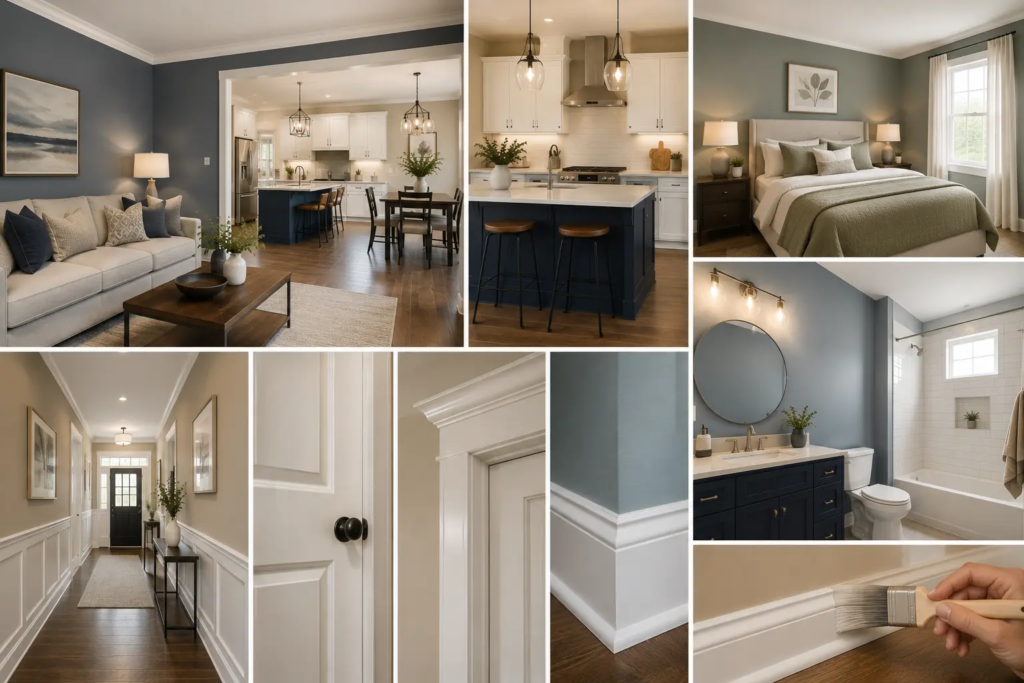
Choosing a paint color gets most of the attention during an interior painting project. However, the paint finish can be just as important.
Two walls painted the exact same color can look very different when one uses a flat finish and the other uses satin.
Paint finish affects sheen, light reflection, appearance, cleaning, and how noticeable surface imperfections may be.
The right choice also depends on where the paint will be used.
A quiet adult bedroom has different demands from a busy hallway. A bathroom has different conditions from a living room. Doors and baseboards receive more physical contact than ceilings.
For homeowners in Wheaton, Naperville, Elgin, Geneva, Addison, Hanover Park, and surrounding western suburbs of Illinois, understanding the basic differences between finishes can make selecting interior paint much easier.
What Does Paint Finish Mean?
Paint finish refers primarily to how much light the dried painted surface reflects.
You may also hear the term paint sheen.
Common interior finishes include:
- Flat
- Matte
- Eggshell
- Satin
- Semi-gloss
- Gloss or high-gloss
The terminology can vary between manufacturers.
One company’s matte product may not behave exactly like another company’s matte paint.
For that reason, homeowners should evaluate the specific product rather than relying entirely on the finish name.
What Is Flat Paint?
Flat paint has very little visible sheen.
Because it reflects less light, it can create a soft appearance.
Flat finishes can also make certain minor wall imperfections less noticeable than higher-sheen alternatives.
This makes flat paint a common consideration for ceilings and selected low-traffic spaces.
However, traditional flat finishes may not tolerate cleaning as well as higher-sheen options.
Modern paint technology has changed this somewhat, and some premium flat products are designed with improved durability.
Always evaluate the characteristics of the specific product.
What Is Matte Paint?
Matte paint is similar to flat paint but may have slightly more sheen depending on the manufacturer.
It can provide a smooth, sophisticated appearance without creating strong reflections.
Matte finishes are often considered for:
- Bedrooms
- Living rooms
- Dining rooms
- Offices
- Low-to-moderate traffic areas
Again, product performance varies.
Some modern matte paints are designed to provide greater washability than traditional flat paint.
What Is Eggshell Paint?
Eggshell gets its name from its subtle sheen.
It reflects more light than flat or matte paint but less than satin.
For many homeowners, eggshell offers a useful balance between appearance and practical maintenance.
It is commonly considered for:
- Living rooms
- Bedrooms
- Dining rooms
- Hallways
- Family rooms
Whether eggshell is appropriate for a specific high-traffic area depends on the paint product and expected cleaning requirements.
What Is Satin Paint?
Satin provides more noticeable sheen than eggshell.
It is frequently considered for rooms and surfaces where additional cleaning may be necessary.
Potential uses include:
- Hallways
- Children’s rooms
- Family rooms
- Kitchens
- Bathrooms
- Entryways
Satin can reflect more light from windows and fixtures.
This can be attractive, but it can also make some surface imperfections more visible.
Wall preparation becomes particularly important when using finishes with more sheen.
What Is Semi-Gloss Paint?
Semi-gloss creates a more reflective surface.
It is commonly used on architectural details and surfaces that receive frequent contact.
Examples include:
- Baseboards
- Interior doors
- Door frames
- Window trim
- Certain cabinets
- Moldings
Using semi-gloss trim alongside lower-sheen walls can also create subtle visual contrast, even when the colors are similar.
What Is High-Gloss Paint?
High-gloss finishes create significant reflection.
They can produce a dramatic appearance when used intentionally.
However, high-gloss paint also tends to make surface imperfections easier to see.
Careful preparation is especially important.
For most residential interiors, high-gloss is used more selectively than eggshell, satin, or semi-gloss.
What Is the Best Paint Finish for Living Rooms?
Living rooms generally do not experience the same moisture conditions as kitchens and bathrooms.
However, family living rooms can still receive significant daily traffic.
Eggshell is commonly considered because it provides some sheen without creating a highly reflective appearance.
Matte may also work well in lower-traffic or more formal living spaces.
Satin may be considered when increased cleanability is a priority.
The best option depends on how the room is actually used.
What Paint Finish Is Best for Bedrooms?
Adult bedrooms often experience relatively low wall contact.
Matte and eggshell finishes can both be considered.
Children’s bedrooms may require a different approach.
Fingerprints, toys, furniture, and everyday activity can create more frequent cleaning needs.
Eggshell or satin may therefore be more practical depending on the specific product.
Do not assume every bedroom in the house requires the same finish.
What Is the Best Paint Finish for Hallways?
Hallways are high-traffic areas.
Hands, bags, pets, furniture, and children can repeatedly contact the walls.
For this reason, many homeowners consider eggshell or satin.
A product that can tolerate routine cleaning may be valuable.
However, wall condition should also be considered.
Higher sheen can make dents, patches, and uneven areas more visible.
Proper preparation should come first.
What Is the Best Paint Finish for Kitchens?
Kitchens can experience moisture, fingerprints, food residue, and frequent cleaning.
A more maintainable wall finish may therefore be appropriate.
Satin is commonly considered for kitchen walls.
Some homeowners may also use eggshell depending on the product.
The area being painted matters.
Kitchen walls, cabinets, doors, trim, and ceilings may all require different products or finishes.
What Is the Best Paint Finish for Bathrooms?
Bathrooms experience changing humidity and moisture.
Paint selection should account for those conditions.
Satin is commonly considered for bathroom walls, although specialized bathroom paint products may be available in other finishes.
Good ventilation also matters.
Paint alone cannot solve an excessive moisture problem.
If a bathroom has persistent condensation, peeling paint, or other moisture-related issues, determine the underlying cause before repainting.
What Finish Should You Use on Ceilings?
Flat paint is commonly used for ceilings.
Its low sheen can reduce visible reflection and help create a uniform appearance.
However, not every ceiling has the same requirements.
Bathroom or kitchen ceilings may have different conditions from bedroom ceilings.
Specialty ceiling paints are also available.
The product should match the environment and surface.
What Paint Finish Is Best for Doors?
Interior doors receive frequent contact.
Hands touch them constantly.
Children and pets can also contribute to wear.
Semi-gloss is commonly considered for doors because of its appearance and cleaning characteristics.
Satin may also be appropriate depending on the desired look and paint product.
The condition of the door should be addressed before applying a higher-sheen finish.
What Finish Should You Use on Baseboards and Trim?
Semi-gloss is one of the most common choices for interior trim.
It can create visual separation between walls and architectural details.
It is also frequently selected for surfaces that require cleaning.
Baseboards experience contact from:
- Shoes
- Vacuum cleaners
- Furniture
- Pets
- Cleaning equipment
A suitable finish can make maintaining these surfaces more practical.
Should Walls and Trim Have Different Finishes?
Often, yes.
Even when walls and trim use similar colors, changing the sheen can create visual distinction.
For example, walls could use eggshell while trim uses semi-gloss.
Light interacts differently with each surface.
This creates contrast without requiring dramatically different colors.
However, using the same finish throughout can also be a deliberate design choice in certain interiors.
Does Higher Sheen Mean More Durable Paint?
Not always.
Historically, higher-sheen paints were often associated with greater washability and durability.
Modern paint formulations have made the relationship more complicated.
Some premium matte or eggshell products are engineered to provide strong performance.
This is why homeowners should compare the characteristics of the actual product rather than assuming that more shine automatically means better paint.
Does Paint Sheen Make Wall Imperfections More Visible?
Generally, greater reflection can make surface irregularities easier to notice.
Light can highlight dents, patches, uneven texture, and poor repairs.
This is particularly important when painting older walls.
If you want to use satin or a higher-sheen finish, proper surface preparation becomes even more important.
Paint cannot correct a poorly prepared wall.
Does Paint Finish Change the Color?
The actual paint color may be the same, but the way you perceive it can change.
Different sheen levels reflect light differently.
A satin version of a color can therefore appear somewhat different from the same color in matte.
Lighting also affects this perception.
If exact appearance matters, evaluate actual samples in the selected finish.
How Lighting Affects Paint Sheen
Rooms with large windows may make reflective finishes more noticeable.
Artificial lighting can also create highlights across satin and semi-gloss walls.
Before selecting a finish, look at the room during different times of day.
Consider where windows, ceiling lights, lamps, and other light sources are located.
This is particularly important for long walls where reflected light can reveal surface irregularities.
Can You Use the Same Finish Throughout the Entire House?
You can, but it may not be the best solution for best paint finish for each area.
Different rooms have different demands.
Using eggshell everywhere may be simple, but bathrooms, ceilings, trim, doors, and high-traffic areas can benefit from different products or finishes.
A whole-house painting plan can still remain consistent while adapting the finish to each surface.
Paint Finish and Indoor Air Quality
Finish is only one part of choosing interior paint.
Homeowners may also want to consider product composition and ventilation during painting.
The U.S. Environmental Protection Agency’s guidance on indoor air quality during remodeling discusses paints, coatings, ventilation, VOCs, and other indoor environmental considerations during remodeling projects.
Following manufacturer instructions and maintaining appropriate ventilation are important regardless of the paint finish selected.
Professional Interior Painting in Naperville and Wheaton
Homes throughout the western suburbs contain many different surfaces.
A Naperville family home may need durable finishes in hallways and children’s rooms.
An older Wheaton property may require careful preparation before higher-sheen finishes are applied.
Properties in Geneva, Elgin, Addison, and Hanover Park can have completely different requirements.
The best finish should be selected based on the room, surface, condition, lighting, and expected use.
Frequently Asked Questions About best paint finish for each area
What is the best paint finish for interior walls?
There is no single best finish. Matte, eggshell, and satin are all commonly used for interior walls. The correct choice depends on the room, wall condition, desired appearance, and cleaning requirements.
Is eggshell or satin better for walls?
Eggshell has less sheen, while satin is generally more reflective. Satin may be considered for higher-traffic areas, while eggshell is popular in living rooms and bedrooms.
What paint finish is easiest to clean?
Higher-sheen finishes have traditionally been easier to clean. However, modern paint technology has produced washable products across several sheen levels. Compare the specifications of the specific paint.
What paint finish should I use in a bathroom?
Satin is commonly considered for bathroom walls. Specialty bathroom products may also be available. Ventilation and moisture conditions should be considered.
What paint finish should I use in a kitchen?
Satin is a common option for kitchen walls because kitchens may require more frequent cleaning. The appropriate product depends on the surface and environment.
What finish should I use on baseboards?
Semi-gloss is commonly used on baseboards and trim because these surfaces experience frequent contact and cleaning.
What is the best paint finish for ceilings?
Flat is commonly used because it provides minimal reflection. The appropriate product may vary for kitchens, bathrooms, and other special environments.
Does satin show wall imperfections?
Its additional reflection can make some dents, patches, and uneven surfaces easier to notice. Proper preparation is important.
Does Crestora Home Services help homeowners choose paint finishes?
Crestora Home Services provides professional residential painting throughout Wheaton, Naperville, Elgin, Geneva, Addison, Hanover Park, and surrounding western suburbs of Illinois. Paint and finish decisions can be evaluated according to the specific rooms and surfaces involved.
Choose the Finish Based on the Surface
There is no reason every painted surface in your home should use the same finish.
A ceiling does not experience the same conditions as a hallway.
A bathroom is different from a bedroom.
A door receives more physical contact than a living room wall.
Start by evaluating how each room is used.
Then consider appearance, wall condition, lighting, cleaning requirements, and the characteristics of the specific paint product.
Crestora Home Services provides professional interior painting throughout the western suburbs of Illinois.
If you are planning an interior painting project, request a free painting quote based on your home’s rooms, surfaces, colors, and desired finishes.