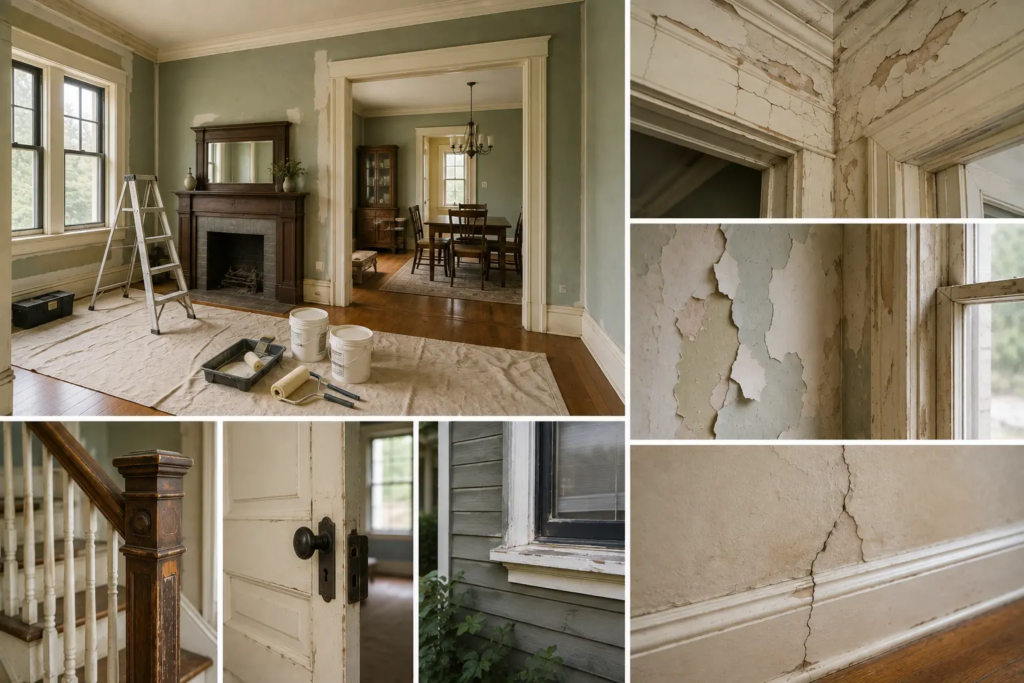
Older homes often have character that newer construction cannot easily reproduce.
Original trim, detailed moldings, solid wood doors, plaster walls, built-in cabinetry, and distinctive architecture can make an older property special.
They can also make painting more complicated.
Painting an older home is not always as simple as selecting a new color and applying two coats. Previous paint layers, surface damage, plaster repairs, aging caulk, moisture issues, and potentially lead-based paint can all affect the project.
For homeowners in Wheaton, Naperville, Elgin, Geneva, Addison, Hanover Park, and surrounding western suburbs of Illinois, evaluating the condition and age of the home before painting can help determine the right approach.
Why Is Painting an Older Home Different?
Older properties have had more time to accumulate repairs and modifications.
A wall may have been painted many times.
Trim may contain several layers of coating.
Previous homeowners may have patched surfaces using different materials.
Common conditions include:
- Cracked plaster
- Peeling paint
- Multiple paint layers
- Old nail holes
- Uneven repairs
- Aging caulk
- Damaged trim
- Water stains
- Worn doors
- Surface imperfections
These conditions do not automatically mean painting will be difficult.
They do mean the surfaces should be inspected before work begins.
Start With the Age of the Home
Knowing approximately when your house was built can provide useful information.
This becomes particularly important for homes constructed before 1978.
The U.S. Environmental Protection Agency states that homes built before 1978 are more likely to contain lead-based paint. Renovation and painting preparation that disturbs those surfaces can create hazardous lead dust.
This does not mean every painted surface in an older home contains lead.
It means the possibility should be taken seriously before sanding, scraping, cutting, or otherwise disturbing old coatings.
What About Lead-Based Paint?
Lead deserves special consideration when working on older properties.
The federal government banned consumer use of lead-based paint in residential applications in 1978. However, lead-based coatings remain present in many older American homes.
A newer layer of paint does not necessarily tell you what exists underneath it.
This is particularly relevant when preparation requires disturbing multiple layers.
The EPA’s Renovation, Repair and Painting guidance for homeowners provides detailed information about lead-safe practices and recommends that owners of pre-1978 homes hire lead-safe certified contractors when renovation, repair, or painting work may disturb old paint.
This is the high-authority external resource I recommend linking from this article.
Does Painting Over Old Paint Solve the Problem?
Not necessarily.
New paint performs best when the underlying surface is suitable for coating.
If the existing paint is firmly adhered and the surface is otherwise appropriate, complete removal may not be necessary.
Problems arise when existing layers are:
- Peeling
- Flaking
- Cracking
- Bubbling
- Loose
- Contaminated
- Poorly bonded
Applying fresh paint over a failing surface does not correct the underlying failure.
The condition should be evaluated first.
Plaster Walls Require Different Attention
Many older homes contain plaster rather than modern drywall.
Plaster can provide a durable wall surface, but older plaster may develop cracks.
Some cracks are cosmetic.
Others may indicate movement or a more significant underlying condition.
Before painting, determine what type of repair is appropriate.
Simply filling every crack with paint will not make it disappear.
Larger or recurring cracks may require further evaluation before cosmetic work begins.
Can You Paint Old Plaster Walls?
Yes.
Plaster walls can produce beautiful painted finishes when properly prepared.
The preparation depends on their condition.
Walls may require cleaning, patching, sanding, or appropriate priming.
Previously repaired areas should also be examined.
Different textures or poorly blended patches can become more visible after new paint is applied.
What About Old Drywall?
Not every older home contains plaster.
Homes that have been remodeled may contain a mixture of original materials and newer drywall.
One room may have plaster while an addition uses drywall.
Even an individual wall can contain previous drywall repairs.
This creates another reason to inspect the surfaces rather than assuming every wall requires the same preparation.
Multiple Layers of Paint Can Create Problems
An older door or piece of trim may have been painted many times.
Each new layer adds thickness.
Over time, details in decorative molding can become less defined.
Doors may also begin rubbing against frames.
Paint buildup around hinges and hardware can become noticeable.
This does not automatically mean all previous paint should be removed.
Removing old coatings can create additional concerns, especially when lead-based paint may be present.
The appropriate approach depends on the surface and existing coating.
Older Trim Deserves Special Attention
One of the most attractive features of older homes is often the woodwork.
You may have:
- Wide baseboards
- Crown molding
- Decorative window trim
- Detailed door frames
- Built-in cabinetry
- Paneled doors
- Wainscoting
These surfaces require more detailed work than a large flat wall.
Before repainting them, inspect for chips, cracks, failing caulk, damaged areas, and excessive paint buildup.
Preserving the architectural detail should be part of the painting strategy.
Should You Paint Original Wood Trim?
This is partly a design decision.
Some homeowners want to preserve stained wood.
Others prefer painted trim.
Before painting original woodwork, consider its condition and character.
Once original stained wood is painted, restoring the previous appearance can require substantial work.
Do not make the decision simply because painted white trim is currently popular.
The wood may be an important part of the home’s architectural identity.
Inspect Old Doors Before Painting
Older solid wood doors can be attractive architectural features.
They may also show decades of use.
Look for:
- Chips
- Cracks
- Scratches
- Thick paint buildup
- Loose paint
- Damaged edges
- Poor previous repairs
Doors contain many detailed surfaces.
They also move constantly.
Areas where painted components rub together deserve particular attention.
The EPA specifically identifies doors and door frames as areas where deteriorating lead-based paint in older homes can potentially create dust through friction.
Check Windows Carefully
Older windows can present similar concerns.
Painted window components may experience repeated friction when windows are opened and closed.
This is another area where older coatings should not be aggressively disturbed without considering the possibility of lead.
If the home was constructed before 1978, discuss appropriate preparation before sanding or scraping painted windows.
Never Ignore Water Stains
A stain on an old wall or ceiling should not simply be covered with paint.
First determine why it exists.
Potential sources can include:
- Roof leaks
- Plumbing leaks
- Previous water damage
- Condensation
- Exterior moisture intrusion
The original problem may already have been repaired.
However, you should verify this before painting.
Fresh paint is a finish, not a solution for an active moisture problem.
Peeling Paint Can Indicate Another Problem
Paint can peel for several reasons.
Poor previous preparation may be responsible.
Moisture can also contribute.
Applying another coat without understanding why the existing paint failed may result in the same problem returning.
Inspect the surrounding area.
If there are signs of moisture or material deterioration, address those conditions before proceeding with normal painting.
Older Ceilings May Need Additional Preparation
Ceilings in older properties can reveal years of repairs.
Look for:
- Cracks
- Stains
- Uneven patches
- Peeling paint
- Previous water damage
- Texture differences
Fresh ceiling paint can make these imperfections more noticeable if they are not addressed first.
Evaluate the ceiling under both natural and artificial lighting.
Should You Use Flat Paint on Older Walls?
Lower-sheen finishes can make some surface irregularities less noticeable.
For this reason, matte or flat finishes may be attractive options for certain older walls.
However, appearance is only one factor.
Cleaning requirements and room usage also matter.
A busy hallway may require different considerations from a formal bedroom.
Do not choose a finish solely because the house is old.
Choose according to the specific room and surface.
Higher Sheen Can Reveal Imperfections
Satin and semi-gloss reflect more light.
This can make dents, patches, waves, and other irregularities more visible.
Older walls are rarely perfectly uniform.
That does not mean higher-sheen finishes cannot be used.
It means preparation and expectations matter.
Sometimes the subtle imperfections are part of the character of the home.
Should an Older Home Use Historic Paint Colors?
Not necessarily.
Owning an older house does not require recreating its original color palette.
Some homeowners prefer historically inspired colors.
Others combine original architectural features with contemporary neutrals.
Both approaches can work.
Consider the architecture, flooring, woodwork, furniture, natural light, and personal style.
The goal should be a color scheme that respects the property while still creating a home you enjoy.
Painting an Older Home Before Selling
Older homes can attract buyers specifically because of their character.
Painting everything bright white is not automatically the best strategy.
Consider preserving distinctive architectural features.
At the same time, heavily damaged or inconsistent walls can distract buyers from those features.
A targeted painting strategy may include refreshing:
- Entryways
- Main living spaces
- Hallways
- Bedrooms
- Ceilings
- Selected trim
The condition of each area should guide the decision.
Older Homes in Wheaton and Geneva
Communities throughout the western suburbs contain properties from many different periods.
Wheaton and Geneva, in particular, include older residential areas where homeowners may encounter original trim, plaster walls, older doors, and multiple generations of previous painting.
Homes in Naperville, Elgin, Addison, and Hanover Park can also contain older construction or remodeled sections.
Age alone does not determine the difficulty of a painting project.
The current condition of the surfaces matters more.
Professional Painting for Older Homes
Painting an older property requires careful evaluation.
The fastest approach is not always the best approach.
Before painting begins, identify which surfaces are stable, which need repair, and which may require special preparation.
For pre-1978 homes, the possibility of lead-based paint should also be considered before disturbing existing coatings.
Crestora Home Services provides residential painting throughout Wheaton, Naperville, Elgin, Geneva, Addison, Hanover Park, and surrounding western suburbs of Illinois.
Frequently Asked Questions About Painting Older Homes
Can you paint directly over old paint?
Sometimes, if the existing coating is sound and the surface is suitable. Peeling, cracking, loose, or poorly bonded paint requires additional evaluation and preparation.
Should I worry about lead paint in an older house?
Homes built before 1978 are more likely to contain lead-based paint. EPA guidance recommends lead-safe practices when renovation or painting preparation may disturb painted surfaces in these homes.
Can plaster walls be painted?
Yes. Plaster can provide an excellent painted surface. Cracks, patches, stains, and other imperfections should be evaluated and prepared first.
Should old paint be completely removed before repainting?
Not automatically. Complete removal may be unnecessary and can create additional concerns when older coatings could contain lead. The appropriate preparation depends on the condition of the surface.
What paint finish works well on older walls?
Matte and lower-sheen finishes can make certain imperfections less noticeable. However, room usage and cleaning requirements should also influence the decision.
Should original wood trim be painted?
That is largely a design decision. Consider the quality, condition, and architectural significance of the original wood before covering it with paint.
Can you paint over water stains?
The source of the stain should be identified first. Active moisture problems should be corrected before painting.
Why does old paint keep peeling?
Possible causes include poor previous preparation, moisture, failing underlying coatings, and other surface conditions. The cause should be evaluated rather than simply covered with another coat.
Are professional painters required to follow special rules in pre-1978 homes?
Federal EPA requirements can apply when paid contractors perform renovation, repair, or painting work that disturbs painted surfaces in qualifying pre-1978 homes and child-occupied facilities. Contractors performing covered work generally must be certified and use lead-safe work practices.
Does Crestora Home Services paint older homes?
Crestora Home Services provides professional residential painting throughout Wheaton, Naperville, Elgin, Geneva, Addison, Hanover Park, and surrounding western suburbs of Illinois. The scope and preparation should be determined by the condition and age of the individual property.
Preserve the Character While Refreshing the Home
Older homes do not need to look new.
Their architectural details, original materials, and subtle imperfections can be part of what makes them attractive.
The goal of painting an older home should be to refresh the property without ignoring the conditions underneath the paint.
Inspect the walls. Evaluate plaster and trim. Investigate stains. Consider previous coatings. Be particularly careful before disturbing paint in homes built before 1978.
Then choose colors and finishes that complement the architecture.
Crestora Home Services provides professional interior painting throughout the western suburbs of Illinois.
If you own an older home in the area, request a free painting quote based on the actual condition, age, and painted surfaces of your property.